

Project 104S was a perfect example of this reality. Our task was to take a workhorse—a conventionally powered light commercial logistics truck—strip its internal combustion powertrain, and replace it with a rugged, high-voltage electric drivetrain.
We were not working with a purpose- erected" skateboard" lattice. We were dealing with a traditional sword graduation frame, designed decades ago for a diesel machine and a driveshaft.
As the Lead Systems mastermind specializing in heavy-duty retrofits, I can tell you that marrying 21st-century lithium technology to a 20th-century artificial frame requires further than just wiring plates. It requires brute-force engineering balanced with delicate electronic operation. This case study explores the specific engineering hurdles of planting a 104S Lithium battery system onto a wobbling, flexing truck lattice, and how the JBD Automotive- Grade High Voltage BMS came to be the central nervous system that made it feasible.
The 104S Sweet Spot Defining the Commercial Retrofit Voltage
Before necklace wrenches touched bolts, we had to define the armature. For light-to-medium duty marketable exchanges( Class 3- 5 original), the voltage choice is critical.
Going too low( e.g., 96V or 144V) demands massive currents to achieve the necessary necklace, performing in heavy, ungovernable bobby
cabling and significant I²R heat losses. Going too high( e.g., 800V armature) enters a realm of exponential element costs, taking precious Silicon Carbide( SiC) inverters and specialized charging structure that rarely justify.
We chose a 104S configuration using LiFePO4( LFP) polychromatic cells.
Nominal Voltage:332.8V( at 3.2 V per cell).
Max Charge Voltage:~380V
This ~330V nominal range is the" sweet spot" for marketable EV retrofits. It provides sufficient electromotive force to drive important traction motors without taking fantastic, high-voltage sequestration factors. It allows us to use standard, robust artificial-grade connectors and cabling while keeping current draw within manageable limits during peak cargo scripts, like starting on a grade with a full cargo.
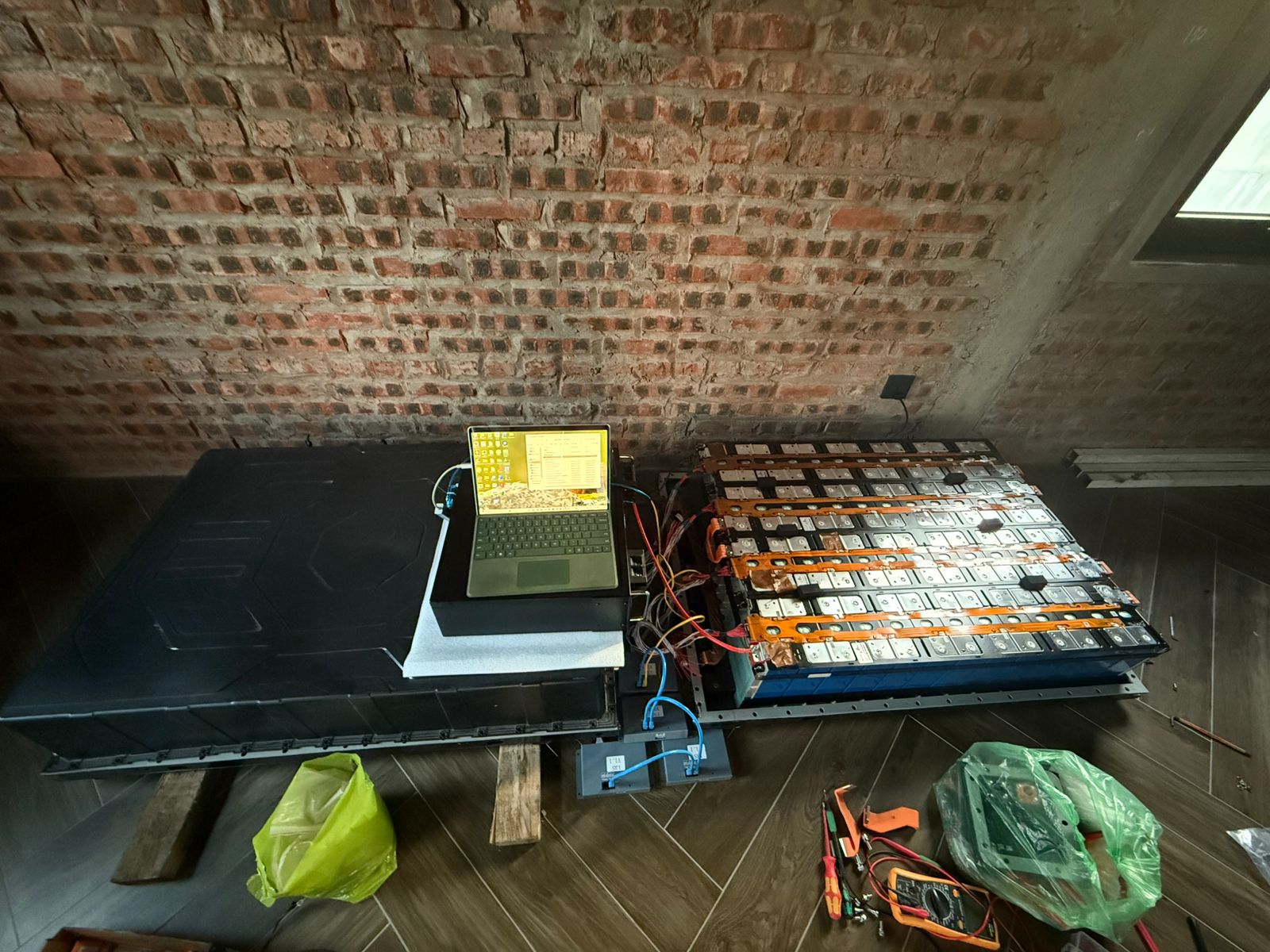
Image Suggestion: Image showing Battery Boxes mounted on a truck frame rails. A split" defile tank" configuration showing robust essence battery enclosures bolted on either side of a sword graduation frame driveshaft lair.
The Physical Challenge Graduation Frames vs. The" Skateboard" Ideal
An ultramodern EV skateboard lattice is rigid and flat — a perfect bed for a battery. A marketable graduation frame is the contrary. It's designed to flex. It twists over uneven road shells; it vibrates intensely.
For design 104S, we could not just drop a monolithic 104-cell pack in the center. The driveshaft, lair, and crossmembers were in the way. We had to borrow a distributed layout, frequently called a" defile tank" configuration. We resolve the 104S system into two 52S sub-packs, mounted externally on the frame rails on either side of the truck to maintain the center of graveness.
This introduced significant engineering headaches
Vibration & Shock The battery boxes are unsprung weight, directly exposed to road impact. The internal factors, especially the BMS and contactors, must repel high G-forces within solder joints cracking or relays welding shut.
HV Routing We now had high-voltage cabling running across the lattice between the two packs. Guarding these lines from bruise and road debris was a primary safety concern.
HVIL Complexity The High Voltage Interlock Loop( HVIL) — the safety circuit that ensures system arrestment if a connector is inaptly seated, has to run a much longer, more complex path around the entire frame.
The Nervous System Implementing JBD’s Automotive-Grade HV BMS
Given the harsh terrain of a build graduation frame, a standard artificial BMS would fail within a month. The constant vibration would shatter standard PCB factors, and road smut would compromise non-sealed enclosures.
For design 104S, we stationed the JBD Automotive- Grade High Voltage BMS. This was not just about covering cell voltages; it was about survival.
Engineering Challenge# 1: Surviving the Industrial Environment
The BMS unit had to be mounted near the main contactor box, exposed to the rudiments under the truck bed. We employed JBD’s ruggedized tackle armature.
IP67 quadrangle The BMS is housed in a bones-cast aluminum quadrangle, completely sealed against dust and high-pressure water spray. This is non-negotiable for under-lattice underpinning.
Automotive Connectors We employed locking, sealed automotive-grade connectors( like Amphenol or TE connectivity components) for all sensing and communication harnesses, precluding shake-outs during operation.
Vibration Dampening The internal PCB is conformal carpeted to cover against moisture and mounted with vibration-dampening standoffs to insulate sensitive dimension electronics from frame harmonics.
Image Suggestion Image of the JBD BMS inside a ruggedized essence quadrangle. near over on the bones- cast aluminum covering showing sealed, automotive-grade connectors and cooling fins.
Engineering Challenge# 2: Reinventing the Distributed Beast
Managing a split 104S pack requires careful consideration of current seeing and contactor placement. We decided on a centralized Master BMS approach.
While the cells were resolved physically, electrically, they remained in series. The JBD BMS was configured to cover temperatures across both distinct physical packs. Crucially, the HVIL circuit was designed to run in series through the service disconnects of both defile tanks. However, the entire HV system is inoperable, icing safety, if an automatic opens either battery box for service. The JBD BMS monitors the integrity of this extended HVIL circle continuously before allowing the main contactors to close.
Engineering Challenge# 3 The Protocol Handshake( VCU Integration)
A build is a" Frankenstein" terrain. You have a motor and regulator from one supplier, a throttle pedal from the original vehicle, and a new aftermarket Vehicle Control Unit( VCU) trying to run the show.
The BMS must be the single source of truth for the battery's state. However, the truck does not move if the BMS and VCU can not talk.
We employed the JBD BMS's completely configurable CAN machine interface( CAN 2.0 B). The challenge was mapping the specific CAN IDs needed by the aftermarket VCU. We had to configure the BMS to broadcast vital parameters — State of Charge( SOC), Discharge Current Limit( DCL), and Charge Current Limit( CCL) — at the exact frequency ( e.g., 10ms intervals) the VCU anticipated.
Case Study: Limelight Working High Inrush Current on Start-up
During original track testing, we encountered a critical issue. When the motorist floored the accelerator from a dead stop while carrying a disassembled 2-ton cargo, the VCU demanded maximum acceleration incontinently. The performing flux of current from the battery was massive, causing the BMS to spark its" Short Circuit Protection" and incontinently open the contactors, killing the truck incontinently.
The motor regulator's internal capacitors were draining the battery too presto, looking like a dead short to the BMS.
The JBD Solution: We could not just disable the protection; that would be dangerous. Rather, we employed the advanced configuration software of the JBD HV BMS to tune the protection sense.
Pre-charge Optimization We increased the pre-charge downtime window, icing the motor regulator's capacitors were completely matched to the pack voltage before the main contactor closed.
Current- Time wind Mapping. We acclimated the over-current protection detector from an immediate value to a time-limited wind. We configured the BMS to allow a 300A shaft for over 2 seconds( sufficient to get the rolling indolence moving) before setting down to the nonstop 150A standing.
This tuning allowed for the necessary" breakaway necklace" without compromising the safety limits of the 104S cells.
Conclusion: The Future of Retrofitting is Rugged
design 104S demonstrated that converting heritage ICE lattice to electric is a feasible, cost-effective strategy for marketable lines, but it isn't a draw- and- play exercise. The hostile physical terrain of a graduation frame demands factors that are far tougher than standard energy storage results.
By using the voltage sweet spot of a 104S system and the rugged, configurable intelligence of the JBD Automotive- Grade BMS, we successfully delivered a work truck that retains its original mileage while embracing a zero- emigration powertrain.
still, communicate our engineering platoon to bandy how our High Voltage results can meet the demands of the real world, if you're negotiating a marketable EV build or a technical heavy-duty lattice.