

Strategic Overview (Macro): The Imperative for Predictive AI Battery Management
For asset owners, operators, and investors, the financial model for large-scale battery energy storage is undercut by a fundamental vulnerability: reactive management. Traditional systems monitor basic parameters, sounding alarms only after a fault has begun—be it accelerated degradation or the precursors to thermal runaway. This operational lag translates directly into unplanned downtime, catastrophic asset loss, and eroded investor confidence. The evolution from simple monitoring to true prediction is no longer a technical luxury; it is a strategic imperative for asset longevity, insurance viability, and total cost of ownership (TCO) optimization. Modern **AI Battery Management** represents this critical shift, transforming the battery from a passive asset into an intelligently managed, predictable component of your financial portfolio.

Engineering the Predictive Edge: Core Architectures of AI Battery Management
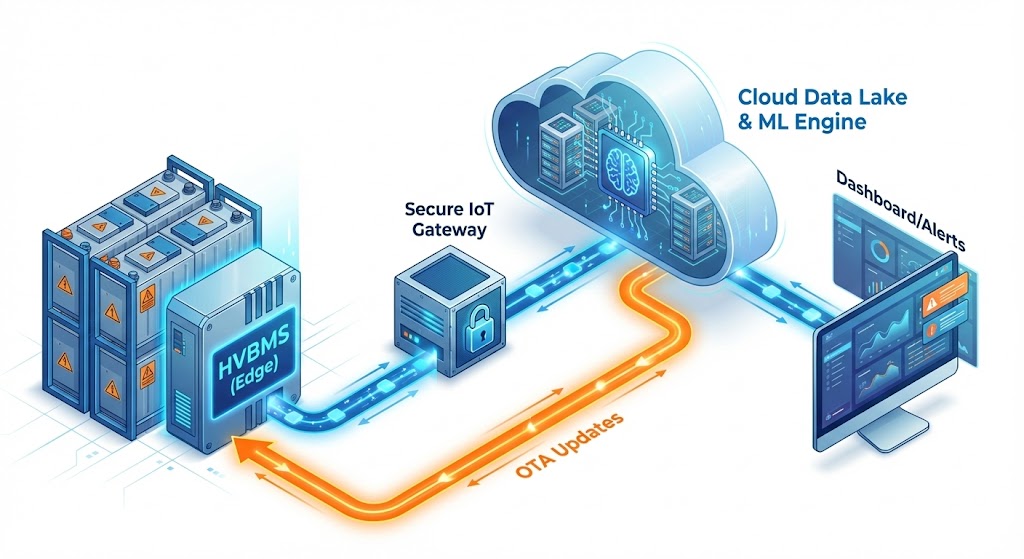
The predictive capability of an advanced HV BMS is not a single feature but an integrated architecture. It begins at the cell level with high-precision sensing, capturing not just voltage (V), current (I), and temperature (T), but high-frequency temporal data like impedance trends. This rich data stream is securely transmitted via a gateway to a cloud-based data lake. Here, machine learning (ML) engines process the information, identifying complex patterns invisible to threshold-based logic. Crucially, this system forms a closed loop: insights and refined algorithms are pushed back to the edge device via secure over-the-air (OTA) updates, creating a self-improving system. This Cloud-BMS integration is the backbone that enables fleet-level analytics and centralized, proactive command. NREL Report on Grid Energy Storage Management | National Renewable Energy Laboratory.
Technical Deep Dive (Micro): The Algorithms of Anticipation – SOH, RUL, and Failure Forecasting
The business value of prediction is built on specific technical methodologies. For State-of-Health (SOH) and Remaining Useful Life (RUL) estimation, JBD's system employs techniques like Long Short-Term Memory (LSTM) networks, which are exceptionally adept at modeling time-series data to forecast degradation trajectories. This moves far beyond simplistic calendar- or cycle-based models. For critical safety forecasting, such as thermal runaway risk, the system performs multi-parameter anomaly detection. It correlates subtle, early-warning signals—like changes in the voltage differential per temperature (dV/dT), internal pressure trends, or cell imbalance growth—that individually may be benign but together form a high-probability failure signature. This algorithmic approach fundamentally changes the risk profile.
Quantifying the Advantage: Risk Mitigation and Financial Modeling for Investors
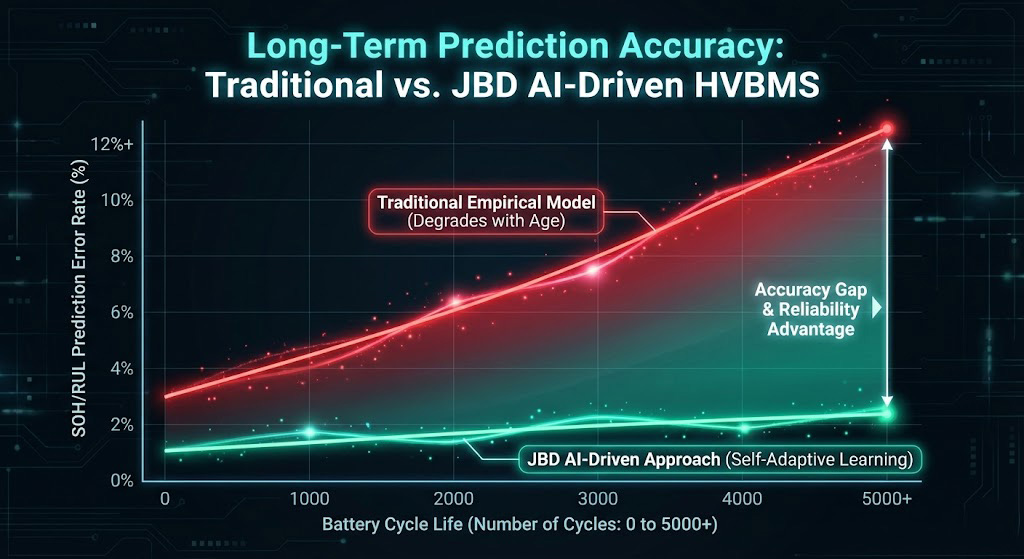
The transition to a predictive **AI Battery Management System** must be justified in the language of finance and risk. The ROI is captured through multiple vectors: a 15-25% reduction in total lifecycle O&M costs by replacing emergency repairs with scheduled, condition-based maintenance; up to a 5% increase in energy throughput by optimally managing charge/discharge cycles to avoid deep degradation states; and significant mitigation of catastrophic loss risk. For insurers and warranty providers, the ±2-3% accuracy in SOH prediction allows for more precise risk modeling, potentially enabling longer-term performance guarantees and revised premium structures. The ability to forecast thermal runaway with 24-72 hours of advance warning at a target false positive rate of <0.1% transforms asset safety from a hope into a managed variable NFPA 855 Standard for the Installation of Stationary Energy Storage Systems | National Fire Protection Association.
Implementation Roadmap: From Installation to Insights
Deploying a predictive BMS is a strategic project, not just a component swap. The roadmap begins with a system compatibility assessment, ensuring sensor data quality and communication infrastructure. The subsequent data integration phase establishes a secure pipeline to the cloud platform. A critical period follows: the initial 30-60 days of site-specific operational data collection, during which the generalized AI model personalizes its predictions to your unique assets and usage patterns, converging to its stated accuracy band. Concurrently, stakeholders must define alert severity tiers and corresponding response protocols, integrating predictive metrics into existing operational playbooks to realize the full value of early warnings.
Frequently Asked Questions
**Q: How does predictive SOH extend the actual warranty or service contract we can offer?**
By providing a data-driven, condition-based view of battery health with approximately 3x greater accuracy than traditional empirical models, insurers and O&M providers can move away from conservative, time-based warranties. This enables the structuring of longer-term performance guarantees and service contracts, as the actual risk of unexpected failure is dramatically reduced and better quantified.
**Q: What is the tangible ROI for a 100MWh energy storage site?**
Financial modeling based on industry benchmarks indicates that for a 100MWh site, the implementation of a predictive AI BMS can yield a 15-25% reduction in total lifecycle operations and maintenance costs. This is achieved by avoiding catastrophic failures and enabling proactive, scheduled maintenance. Additionally, by optimizing cycles to prevent deep degradation, sites can realize up to a 5% increase in total energy throughput over the asset's life, directly boosting revenue.
**Q: How reliable are the "early warnings" for thermal runaway? What is the false positive rate?**
Reliability is paramount. JBD's system employs a multi-parameter correlation engine that cross-validates multiple early-indicator signals—such as subtle voltage noise, localized temperature gradients, and pressure trends—before triggering an alert. This sophisticated approach is designed to achieve a target false positive rate of less than 0.1%, ensuring that alerts are highly credible and warrant immediate investigation.
**Q: Does the AI model require proprietary battery data to start, and how long does it take to become accurate?**
No proprietary cell data is required for initialization. The system begins with a robust, generalized model trained on diverse datasets. It then personalizes itself using your site's operational data. Typically, after 30 to 60 days of collecting this site-specific data, the model refines its predictions to operate within the stated ±2-3% accuracy band for SOH and RUL.
**Q: How does this integrate with existing SCADA or plant management systems?**
Integration is designed for minimal disruption. The Cloud-BMS platform provides industry-standard interfaces, including REST APIs, MQTT for data streaming, and protocols like Modbus TCP. This allows predictive health metrics, state-of-charge (SOC), and early-warning alerts to be seamlessly delivered as new data points directly into your existing SCADA, EMS, or plant management dashboard.
Ready to Scale?
Stop allowing unpredictable battery degradation and safety risks to undermine your project's financial returns and operational stability. Deploy the JBD **AI Battery Management System** to transform your energy assets from cost centers into predictable, high-performance investments. **Download the full Predictive BMS Datasheet or book a strategic consultation with our engineering team today to model your specific ROI.**