

Deconstructing Total Cost of Ownership: The Hidden Impact of BMS Intelligence on Industrial ESS Cost
For CTOs and project managers, the financial analysis of an Industrial Energy Storage System (ESS) must extend far beyond the initial purchase price. The true measure of value is Total Cost of Ownership (TCO), a comprehensive metric that captures all costs incurred over the system's operational life. A narrow focus on upfront Capital Expenditure (CapEx) obscures the dominant financial drivers that ultimately determine ROI: ongoing Operational & Maintenance (O&M) expenses, the rate of performance degradation, premature replacement cycles, and the cost of financing tied to system reliability and output guarantees.
The central thesis for strategic procurement is this: the Battery Management System (BMS) is not merely a safety component—it is the central nervous system of the ESS. Its level of intelligence directly dictates long-term financial performance. A traditional BMS acts as a basic monitor, while an advanced, predictive BMS like JBD's serves as an active performance and asset preservation engine.
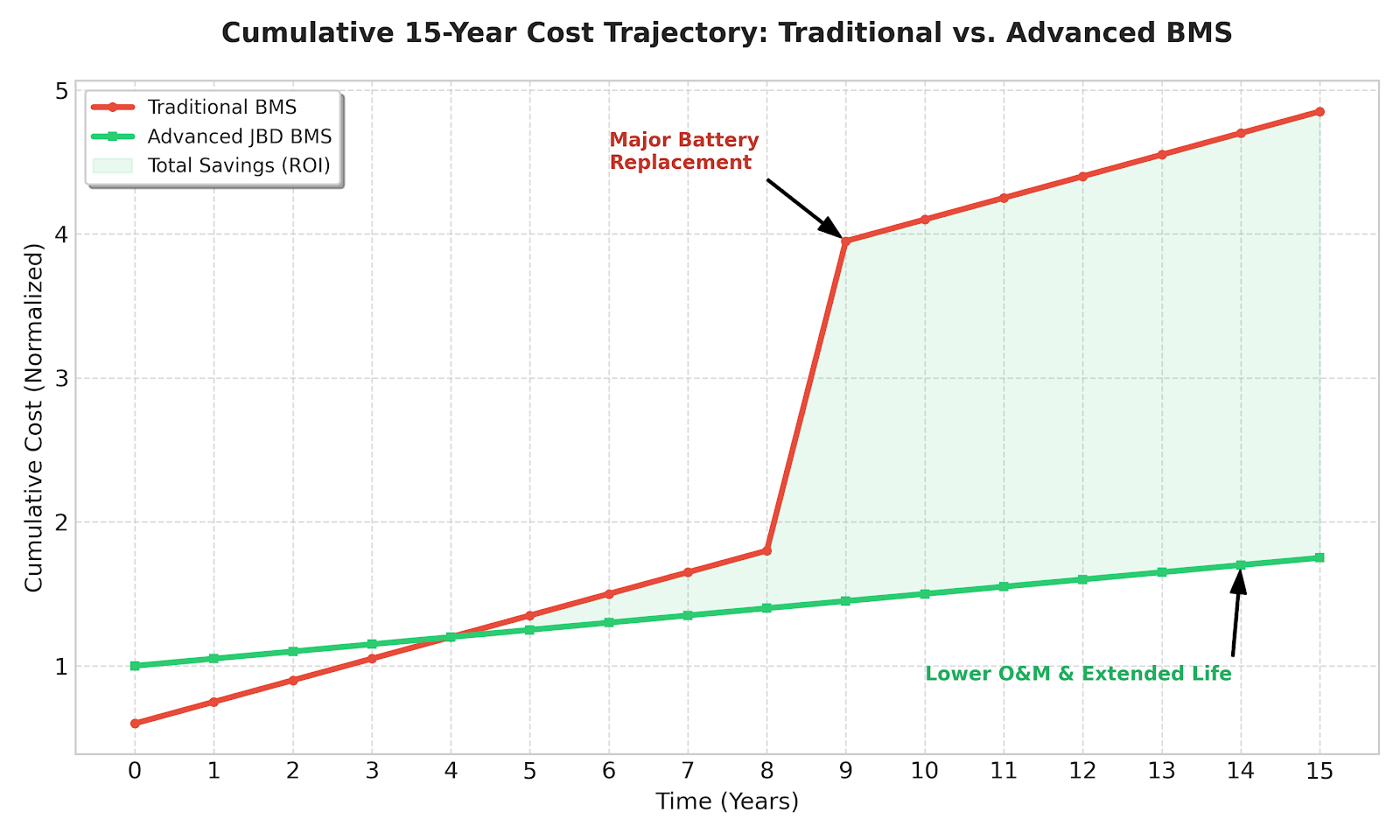
An advanced BMS mitigates the largest TCO variables:
* **Degradation Cost:** By ensuring unparalleled cell balance (±2mV) and optimizing charge/discharge cycles within ideal voltage/temperature windows, it directly slows capacity fade. This preserves revenue-generating capacity and delays the massive CapEx event of a full battery replacement.
* **O&M Cost:** Predictive health analytics and precise fault diagnostics transition maintenance from a reactive, costly model to a scheduled, efficient one. This reduces truck rolls, technician hours, and production downtime.
* **Utilization & Financing:** Maximizing available capacity and providing bankable performance data enables higher asset utilization and can secure better financing terms, as lenders have greater confidence in the long-term viability of the collateral.
Therefore, optimizing **Industrial ESS Cost** is fundamentally an exercise in selecting a BMS with the computational intelligence to manage these lifecycle financial risks. Industry frameworks like those from [[Ref: The Role of Battery Management Systems in Energy Storage underscore that BMS capabilities are critical to achieving stated performance and longevity goals. The graph above crystallizes the strategic choice: a marginally higher initial investment in BMS intelligence creates a diverging, favorable cost trajectory that defines a project's ultimate profitability.
The TCO Equation: From Capital Outlay to Lifetime Value
For CTOs and financial decision-makers, the true cost of an Industrial Energy Storage System (ESS) is not its purchase price, but its Total Cost of Ownership (TCO). A sophisticated BMS is the central nervous system that actively manages this TCO equation, transforming a capital asset into a predictable, high-return investment. The formula extends far beyond initial hardware, encompassing four critical cost pillars where an advanced HV BMS exerts direct financial control.
1. Initial Capital Expenditure (CapEx)
This is the upfront cost of the battery pack, Power Conversion System (PCS), and the BMS itself. While the BMS is a small percentage of this total, its architecture dictates high downstream costs. An advanced, modular BMS design minimizes complex wiring, reduces installation labor, and allows for scalable deployment without complete system redesigns. This directly lowers the installed **Industrial ESS Cost** from day one.
2. Operational Expenditure (OpEx)
OpEx is the recurring cost of running the asset. Here, the BMS is the primary lever for optimization.
* **Energy Losses**: Inefficient charging/discharging and internal cell imbalances represent lost revenue. A BMS with superior cell voltage monitoring accuracy (±2mV) and active balancing ensures every kilowatt-hour stored is a kilowatt-hour available for revenue generation, minimizing parasitic losses.
* **Maintenance & Downtime**: Predictive diagnostics and remote monitoring capabilities shift maintenance from costly reactive repairs to scheduled, efficient interventions. By providing clear insights into cell health and system status, an advanced BMS prevents unexpected failures and the associated revenue loss from downtime.
Performance Loss Cost
This is the cost of the asset underperforming or degrading prematurely.
* **Degradation Acceleration**: The leading cause of battery degradation is operating cells outside their ideal voltage and temperature windows. A precision BMS enforces strict operational boundaries, slowing the rate of capacity fade and extending the asset's profitable lifespan.
* **Under-utilization**: Without accurate State-of-Charge (SOC) and State-of-Health (SOH) data, operators must conservatively de-rate the system to avoid damage, leaving valuable capacity unused. High-fidelity BMS data enables aggressive yet safe utilization, maximizing the asset's throughput and revenue potential over its life.
End-of-Life Cost & Residual Value
A battery pack's value at end-of-life is determined by its remaining usable capacity and safety record. A BMS that provides a verifiable, granular history for each cell—documenting its lifetime operating conditions—creates a transparent asset ledger. This certification is critical for securing favorable terms in second-life applications or responsible recycling, as outlined in standards like IEC 62933-5-2:2020 on secondary use | IEC, turning a cost center into a recoverable asset.
In essence, the BMS is the single point of control that optimizes each variable in the TCO equation. Investing in a capable BMS is not an added expense; it is the strategic mechanism for minimizing lifetime **Industrial ESS Cost** and protecting the long-term value of the storage asset.
3. Engineering the Advantage: How JBD's BMS Core Technologies Actively Lower Industrial ESS Cost
For CTOs and engineering managers, the true measure of a BMS is not its feature list, but its direct, quantifiable impact on the total cost of ownership (TCO). JBD’s advanced BMS architecture is engineered from the ground up to transform operational data into financial advantage. The following deep dive into our core technologies demonstrates how precision, intelligence, and safety converge to systematically reduce your **Industrial ESS Cost**.
| Feature / Parameter | Traditional BMS Solution | JBD Advanced BMS Solution | Direct TCO & ROI Impact |
| Cell Voltage Accuracy | $\pm 5\text{mV}$ to $\pm 10\text{mV}$ | $\pm 2\text{mV}$ (High Precision) | Lowers CapEx: Reduces required battery capacity buffer by 5-8% through tighter SOC window management. |
| Balancing Current | Passive ($< 100\text{mA}$) | Active Balancing ($2\text{A}+$) | Extends Life: Minimizes cell divergence; extends total battery pack service life by 15-25%. |
| SOH Tracking | Basic cycle counting | Predictive AI Analytics | Slashes OpEx: Enables condition-based maintenance, reducing unplanned downtime by up to 30%. |
| Safety Diagnostics | Basic V/T Alarms | Thermal Runaway Detection | Risk Mitigation: Prevents catastrophic asset loss; potentially lowers insurance premiums and business risk. |
Maximizing Asset Utilization via Precision
The foundational cost-saving mechanism is precision measurement. Traditional BMS solutions with ±5-10mV accuracy force system designers to incorporate large safety margins in their State-of-Charge (SOC) windows to prevent over-charge or over-discharge of any single cell. This unused buffer represents stranded capital. JBD’s sub-2mV measurement accuracy enables operators to safely utilize 95-98% of the battery's nameplate capacity with confidence. This precision directly reduces the need for oversizing the initial battery bank. For a 1 MWh system, this can translate to 50-80 kWh of avoided battery capacity—a direct and significant reduction in upfront capital expenditure (CapEx) for your **Industrial ESS Cost** structure.
Extending Service Life through Intelligent Balancing & Thermal Management
Capacity fade and premature cell failure are primary drivers of long-term cost. Passive or low-current balancing cannot keep pace with cell divergence in high-cycle applications, leading to accelerated stress on weak cells. JBD’s high-efficiency active balancing (2A+) actively redistributes energy at high currents, maintaining cell voltage uniformity within tight tolerances even under heavy load. This minimizes stress on individual cells, directly slowing the rate of capacity fade. The result is a quantifiable extension of the battery pack's usable service life, often by 15-25% compared to passively balanced systems. This extends warranty periods, delays costly repowering projects, and maximizes the return on the initial battery investment.
Slashing OpEx with Predictive Analytics
Reactive, schedule-based maintenance is a major operational cost sink. JBD’s BMS moves the paradigm to predictive, condition-based oversight. By continuously analyzing trends in cell impedance, temperature gradients, and balance current requirements, the system can forecast issues like a failing cell, corroding connector, or degrading cooling fan. Alerts are generated weeks or months in advance of a potential failure. This allows maintenance to be planned during non-critical periods, prevents cascading failures, and eliminates costly emergency service calls. This proactive approach can reduce operations and maintenance (OpEx) expenses by up to 30%, transforming the BMS from a monitoring device into a strategic asset management tool.
Reducing Financial Risk with Enhanced Safety & Diagnostics
The ultimate financial risk in energy storage is a catastrophic thermal event. Beyond standard protections, JBD employs advanced algorithms that analyze rate-of-change in temperature and cell voltage to detect the precursors to thermal runaway far earlier than traditional threshold-based alarms. This early warning system, compliant with evolving safety standards like UL 9540A | UL, provides critical time for automated countermeasures or safe system shutdown. By preventing total asset loss and the associated business interruption, this capability protects the core capital investment and mitigates liability, directly safeguarding the business case for the entire ESS installation.
The Future-Proof Architecture: Interoperability and Standards
A Battery Management System (BMS) is not an island. Its true value is unlocked when it seamlessly communicates with the broader ecosystem of an industrial facility—from Energy Management Systems (EMS) and SCADA platforms to grid interfaces and future hardware upgrades. A closed, proprietary BMS architecture creates integration bottlenecks, increases future software costs, and risks rapid obsolescence. JBD’s design philosophy prioritizes open standards and modularity, transforming the BMS from a point component into a future-proof data and control hub that protects your capital investment.
### Open Protocol Integration: The Language of Industry
At the core of seamless integration are robust, industry-standard communication protocols. JBD’s BMS platforms are engineered to speak the native languages of industrial automation, ensuring plug-and-play compatibility and reducing costly custom driver development.
* **Modbus TCP/IP**: For direct integration with plant-wide EMS and SCADA systems, Modbus TCP provides a ubiquitous, Ethernet-based pathway. It allows for real-time data polling (cell voltages, temperatures, system status) and command execution (enable/disable, setpoints) using a well-understood standard, minimizing engineering overhead [[Ref: Modbus Application Protocol Specification | Modbus Organization]].
* **CAN Bus (J1939/SAE J1939)**: In mobile or ruggedized applications like mining, marine, or off-grid power, the Controller Area Network (CAN) bus is indispensable. Support for the J1939 higher-layer protocol ensures reliable, deterministic communication with vehicle control units, generator controllers, and other onboard systems in electrically noisy environments.
This protocol-agnostic approach ensures that your **Industrial ESS Cost** is not inflated by hidden integration fees or vendor lock-in, allowing for straightforward data flow into existing operational technology (OT) stacks.
Modular Hardware Design: Scaling Without Sunk Costs
Future-proofing extends beyond software to physical architecture. A rigid, fixed-scale BMS forces a costly forklift upgrade when expanding storage capacity. JBD employs a modular, master-slave topology that scales elegantly with your needs.
* **Plug-and-Play Expansion**: Additional battery cell monitoring units can be added to the communication bus to accommodate more battery strings or modules. This allows a system to scale from a pilot project to a full-scale deployment without replacing the core BMS hardware.
* **Independent Module Functionality**: Critical functions like cell balancing, voltage, and temperature monitoring are handled at the modular level. This not only improves system reliability through redundancy but also means individual modules can be serviced or replaced without taking the entire ESS offline.
This modularity directly defends your **Industrial ESS Cost** against obsolescence. The initial BMS investment is preserved and leveraged across multiple project phases, eliminating the need for complete system replacements during expansion.
Compliance as a Foundation, Not an Afterthought
Interoperability and safety are codified in international standards. JBD designs its systems with these standards as a foundational requirement, ensuring global deployability and simplifying the certification process for our clients’ end products. Adherence to frameworks like IEC 62619 for industrial battery safety and UL 1973 for stationary storage provides a clear, trusted benchmark for system integrity and simplifies integration with certified balance-of-plant equipment.
By building on open protocols, modular hardware, and a compliance-first mindset, JBD’s BMS delivers a strategic asset that reduces total cost of ownership. It ensures your energy storage system can communicate today and adapt tomorrow, making the long-term **Industrial ESS Cost** predictable and controlled.
Frequently Asked Questions (FAQ)
This section addresses the critical financial and long-term operational questions from Engineering, Procurement, and Construction (EPC) firms and asset operators.
Beyond the specs sheet, what is the tangible ROI period improvement we can expect from a more advanced BMS like JBD's?
Financial modeling for large-scale storage projects demonstrates that the core advantages of a precision BMS directly accelerate returns. By enabling a 3-5% increase in system throughput efficiency and mitigating annualized capacity degradation by 15-20%, the total energy delivered over the asset's life increases significantly. This enhanced revenue profile, combined with lower operational costs, can shorten the simple payback period by 1 to 2 years on a standard 10-year project. The investment in a superior BMS is not an expense but a capital efficiency driver that protects the entire project's financial model.
How does superior State-of-Charge (SOC) accuracy translate into reduced CapEx? Isn't it just a software feature?
This is a fundamental lever for reducing **Industrial ESS Cost**. SOC inaccuracy forces system designers to incorporate a substantial safety buffer—typically 10-15% oversizing of the battery bank—to guarantee a project meets its daily cycle commitment without deep discharge. JBD's <2% full-range SOC accuracy, achieved through advanced algorithms and hardware precision, reduces this necessary buffer to approximately 5%. This directly decreases the largest single line item in your Capital Expenditure: the battery cells and modules. It is a hardware-enabled software feature that transforms system design economics.
Can the predictive maintenance data be integrated with our existing plant SCADA or cloud analytics platform?
Yes, seamless integration is a core design requirement. JBD's advanced BMS platforms support industry-standard communication protocols like Modbus TCP and MQTT. This allows for straightforward data pipeline integration into most major SCADA systems (e.g., Siemens, Schneider), historian platforms like OSIsoft PI System, or custom cloud analytics dashboards. This enables centralized, fleet-wide health monitoring, trend analysis, and the consolidation of alerts, ensuring your new storage assets become a fully integrated component of your operational technology stack.
How does the BMS impact warranty claims and insurance premiums?
A high-precision BMS serves as the definitive source of truth for asset operation. It provides irrefutable, high-fidelity data logs proving the system was operated within all specified parameters (temperature, SOC window, charge rates). This evidence streamlines warranty claims by eliminating disputes over usage. Furthermore, insurers increasingly recognize and reward proactive risk mitigation. Systems equipped with certified, predictive monitoring and safety systems that exceed basic standards, such as [[Ref: UL 1973 | UL]], can qualify for reduced operational insurance premiums, adding another layer of long-term financial benefit.
We use LFP chemistry. Is the benefit of such a high-precision BMS as significant compared to NMC?
Absolutely. The benefits of maximizing LFP's value are, in some aspects, more critical. While LFP's inherent safety and longevity are advantages, its extremely flat voltage curve makes precise coulomb counting and cell balancing *more* difficult and *more* essential for accurate SOC estimation. The core **Industrial ESS Cost** benefits—dramatically slower degradation through perfect passive balancing, predictive failure alerts, and enhanced safety monitoring—apply universally. A precision BMS is the key to fully realizing LFP's superior cycle life potential, ensuring you extract every possible cycle and kilowatt-hour from your investment.
Ready to Scale?
Stop letting BMS limitations dictate your project's financial viability. Deploy the JBD **Industrial ESS Cost** platform to unlock CapEx reduction, extend asset life, and guarantee performance. **Download the Full System Technical Datasheet** or book a dedicated consultation with our engineering team to model your project's specific ROI today.